Tree Notebook
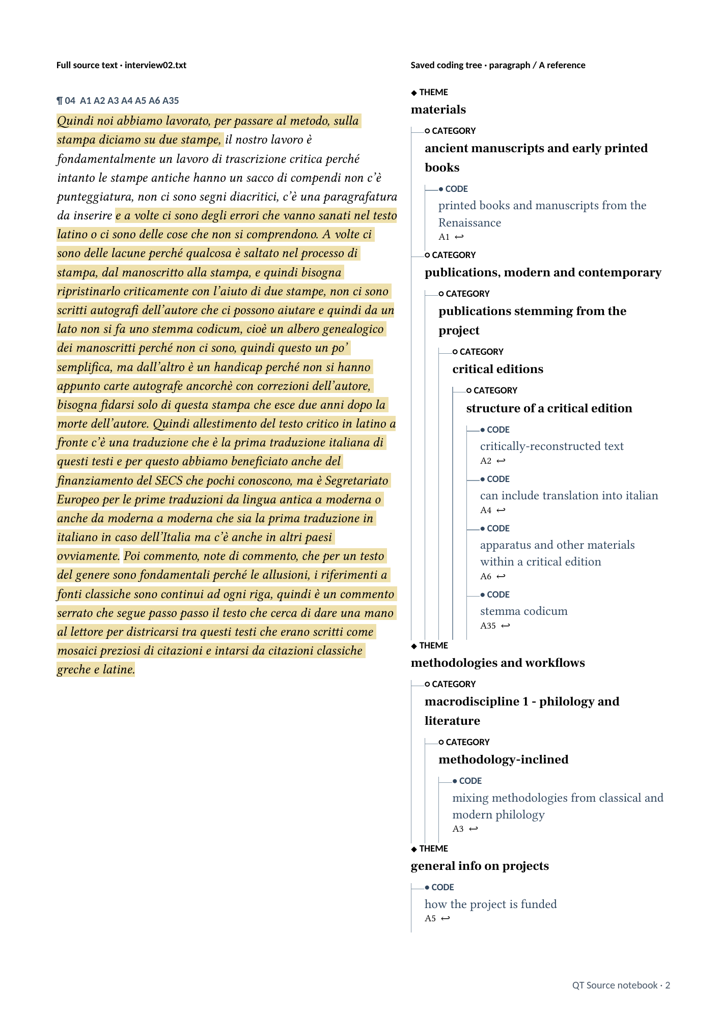
Full interview02.txt text, 53 saved codings, highlights and their tree paths.
Source scope & tree labels
18,239 characters. Explicit display convention: root Theme, intermediate Category, leaf Code. Saved names and links are unchanged.
FIELD NOTES / BOLOGNA · CC0
Read the Notebook and editable report, then trace all five figures to their counts.
Counts passage-code assignments, not participants. Frequency is not importance.
Open the finished files.
One public Bologna record: 19 interviews, 317 defined codes and 874 codings. These files come from the workbench’s existing exporters.
Full interview02.txt text, 53 saved codings, highlights and their tree paths.
18,239 characters. Explicit display convention: root Theme, intermediate Category, leaf Code. Saved names and links are unchanged.
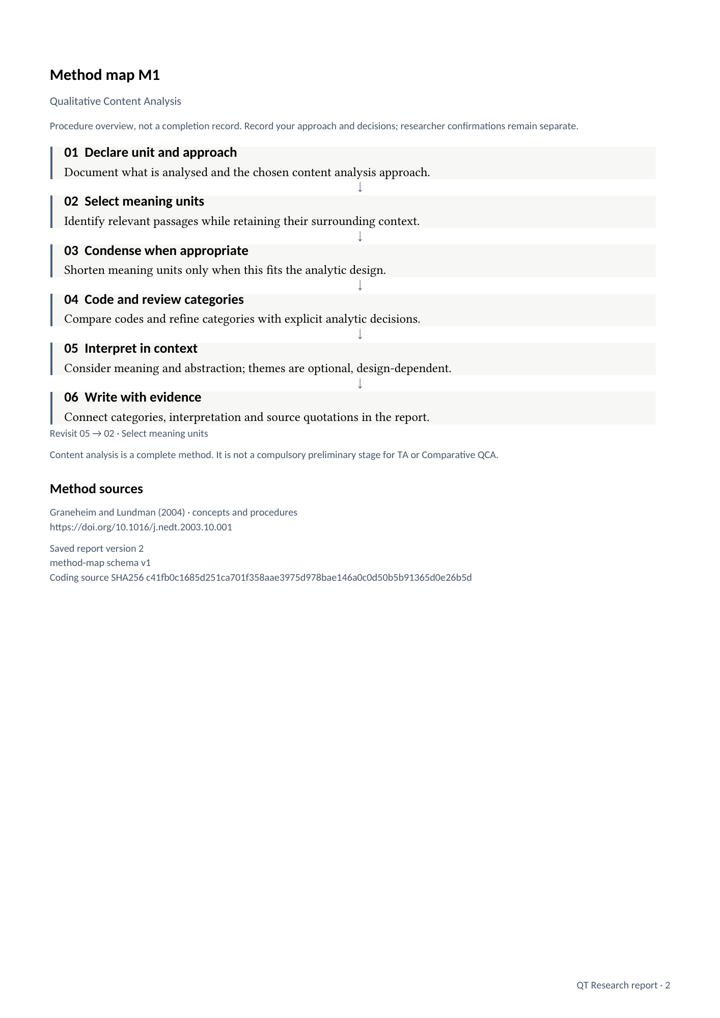
Qualitative Content Analysis, method map, an Analysis Table, illustrative Narrative Analysis and five figures.
SVG, PDF and 300 dpi PNG for each figure, with its CSV and standalone Python script. Extract the ZIP before running the code.
Project JSON preserves all 19 source documents, original coding and the saved example report. Restore it as a new project in your private online account, or use the local workspace.
Illustrative writing from existing codes; not a newly validated research analysis. Word text and tree labels are editable; editing Word does not update QT. The five figures cover the whole corpus; the Notebook covers one complete interview. File hashes & source record ↗
One public corpus. One saved coding record.
Read frequency, distribution, shared ranges, theme structure and accumulation. Every view retains its exported values.
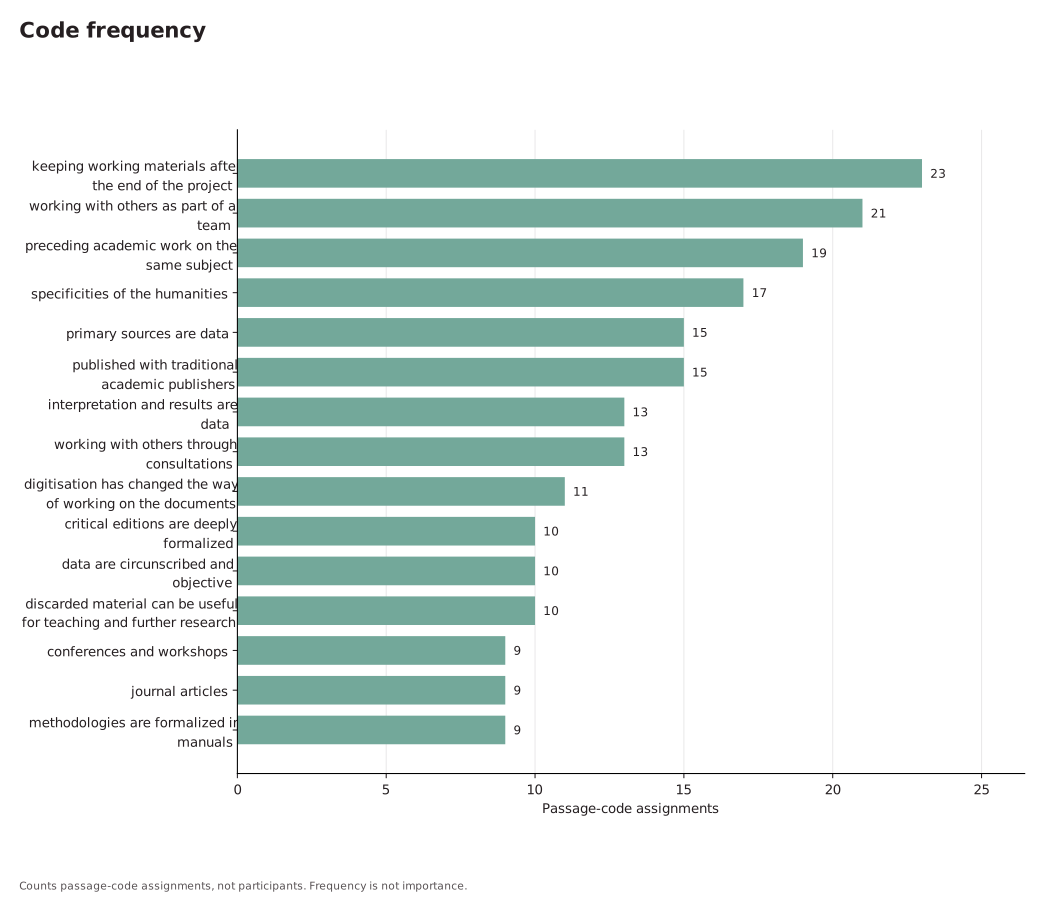
Which codes appear most often in the coding record?
Explore the 15 exported codes. Choose a bar to read the count and find its source row.
Arrow keys to explore · Enter to locate the count row · Escape to clear
| code | count |
|---|---|
| 23 | |
| 21 | |
| 19 | |
| 17 | |
| 15 | |
| 15 | |
| 13 | |
| 13 | |
| 11 | |
| 10 | |
| 10 | |
| 10 | |
| 9 | |
| 9 | |
| 9 |
The five highest displayed counts belong to keeping working materials after the end of the project (23), working with others as part of a team (21), preceding academic work on the same subject (19), specificities of the humanities (17) and primary sources are data (15).
This is a selected view of the codebook. The numbers record coding activity; deciding what a passage means still requires reading it in context. Next, check how these codes are distributed across interviews.
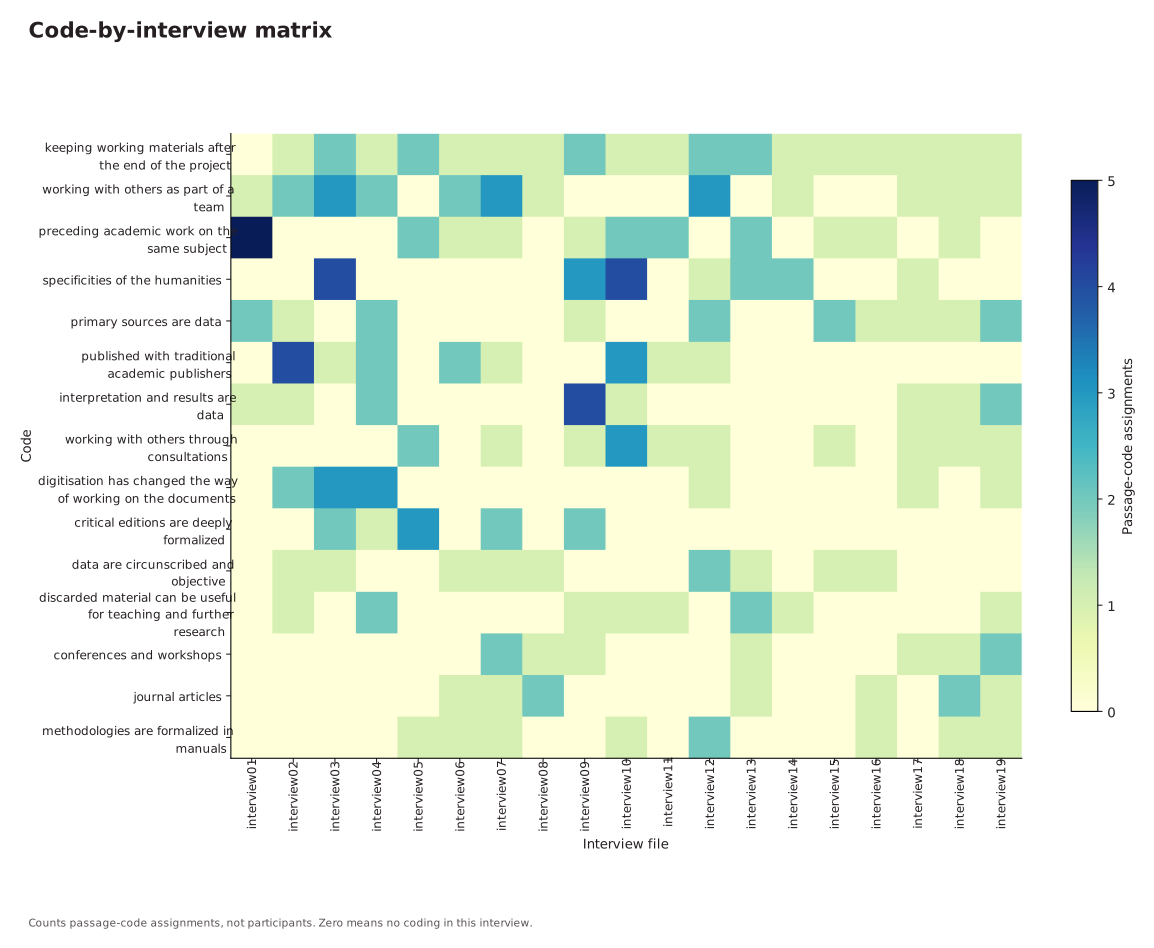
How are the busiest codes distributed across interviews?
19 interviews across, 15 codes down. Choose any cell, including zeros.
Arrow keys to explore · Enter to locate the count row · Escape to clear
| case | code | count |
|---|---|---|
| keeping working materials after the end of the project | 0 | |
| working with others as part of a team | 1 | |
| preceding academic work on the same subject | 5 | |
| specificities of the humanities | 0 | |
| primary sources are data | 2 | |
| published with traditional academic publishers | 0 | |
| interpretation and results are data | 1 | |
| working with others through consultations | 0 | |
| digitisation has changed the way of working on the documents | 0 | |
| critical editions are deeply formalized | 0 | |
| data are circunscribed and objective | 0 | |
| discarded material can be useful for teaching and further research | 0 | |
| conferences and workshops | 0 | |
| journal articles | 0 | |
| methodologies are formalized in manuals | 0 | |
| keeping working materials after the end of the project | 1 | |
| working with others as part of a team | 2 | |
| preceding academic work on the same subject | 0 | |
| specificities of the humanities | 0 | |
| primary sources are data | 1 | |
| published with traditional academic publishers | 4 | |
| interpretation and results are data | 1 | |
| working with others through consultations | 0 | |
| digitisation has changed the way of working on the documents | 2 | |
| critical editions are deeply formalized | 0 | |
| data are circunscribed and objective | 1 | |
| discarded material can be useful for teaching and further research | 1 | |
| conferences and workshops | 0 | |
| journal articles | 0 | |
| methodologies are formalized in manuals | 0 | |
| keeping working materials after the end of the project | 2 | |
| working with others as part of a team | 3 | |
| preceding academic work on the same subject | 0 | |
| specificities of the humanities | 4 | |
| primary sources are data | 0 | |
| published with traditional academic publishers | 1 | |
| interpretation and results are data | 0 | |
| working with others through consultations | 0 | |
| digitisation has changed the way of working on the documents | 3 | |
| critical editions are deeply formalized | 2 | |
| data are circunscribed and objective | 1 | |
| discarded material can be useful for teaching and further research | 0 | |
| conferences and workshops | 0 | |
| journal articles | 0 | |
| methodologies are formalized in manuals | 0 | |
| keeping working materials after the end of the project | 1 | |
| working with others as part of a team | 2 | |
| preceding academic work on the same subject | 0 | |
| specificities of the humanities | 0 | |
| primary sources are data | 2 | |
| published with traditional academic publishers | 2 | |
| interpretation and results are data | 2 | |
| working with others through consultations | 0 | |
| digitisation has changed the way of working on the documents | 3 | |
| critical editions are deeply formalized | 1 | |
| data are circunscribed and objective | 0 | |
| discarded material can be useful for teaching and further research | 2 | |
| conferences and workshops | 0 | |
| journal articles | 0 | |
| methodologies are formalized in manuals | 0 | |
| keeping working materials after the end of the project | 2 | |
| working with others as part of a team | 0 | |
| preceding academic work on the same subject | 2 | |
| specificities of the humanities | 0 | |
| primary sources are data | 0 | |
| published with traditional academic publishers | 0 | |
| interpretation and results are data | 0 | |
| working with others through consultations | 2 | |
| digitisation has changed the way of working on the documents | 0 | |
| critical editions are deeply formalized | 3 | |
| data are circunscribed and objective | 0 | |
| discarded material can be useful for teaching and further research | 0 | |
| conferences and workshops | 0 | |
| journal articles | 0 | |
| methodologies are formalized in manuals | 1 | |
| keeping working materials after the end of the project | 1 | |
| working with others as part of a team | 2 | |
| preceding academic work on the same subject | 1 | |
| specificities of the humanities | 0 | |
| primary sources are data | 0 | |
| published with traditional academic publishers | 2 | |
| interpretation and results are data | 0 | |
| working with others through consultations | 0 | |
| digitisation has changed the way of working on the documents | 0 | |
| critical editions are deeply formalized | 0 | |
| data are circunscribed and objective | 1 | |
| discarded material can be useful for teaching and further research | 0 | |
| conferences and workshops | 0 | |
| journal articles | 1 | |
| methodologies are formalized in manuals | 1 | |
| keeping working materials after the end of the project | 1 | |
| working with others as part of a team | 3 | |
| preceding academic work on the same subject | 1 | |
| specificities of the humanities | 0 | |
| primary sources are data | 0 | |
| published with traditional academic publishers | 1 | |
| interpretation and results are data | 0 | |
| working with others through consultations | 1 | |
| digitisation has changed the way of working on the documents | 0 | |
| critical editions are deeply formalized | 2 | |
| data are circunscribed and objective | 1 | |
| discarded material can be useful for teaching and further research | 0 | |
| conferences and workshops | 2 | |
| journal articles | 1 | |
| methodologies are formalized in manuals | 1 | |
| keeping working materials after the end of the project | 1 | |
| working with others as part of a team | 1 | |
| preceding academic work on the same subject | 0 | |
| specificities of the humanities | 0 | |
| primary sources are data | 0 | |
| published with traditional academic publishers | 0 | |
| interpretation and results are data | 0 | |
| working with others through consultations | 0 | |
| digitisation has changed the way of working on the documents | 0 | |
| critical editions are deeply formalized | 0 | |
| data are circunscribed and objective | 1 | |
| discarded material can be useful for teaching and further research | 0 | |
| conferences and workshops | 1 | |
| journal articles | 2 | |
| methodologies are formalized in manuals | 0 | |
| keeping working materials after the end of the project | 2 | |
| working with others as part of a team | 0 | |
| preceding academic work on the same subject | 1 | |
| specificities of the humanities | 3 | |
| primary sources are data | 1 | |
| published with traditional academic publishers | 0 | |
| interpretation and results are data | 4 | |
| working with others through consultations | 1 | |
| digitisation has changed the way of working on the documents | 0 | |
| critical editions are deeply formalized | 2 | |
| data are circunscribed and objective | 0 | |
| discarded material can be useful for teaching and further research | 1 | |
| conferences and workshops | 1 | |
| journal articles | 0 | |
| methodologies are formalized in manuals | 0 | |
| keeping working materials after the end of the project | 1 | |
| working with others as part of a team | 0 | |
| preceding academic work on the same subject | 2 | |
| specificities of the humanities | 4 | |
| primary sources are data | 0 | |
| published with traditional academic publishers | 3 | |
| interpretation and results are data | 1 | |
| working with others through consultations | 3 | |
| digitisation has changed the way of working on the documents | 0 | |
| critical editions are deeply formalized | 0 | |
| data are circunscribed and objective | 0 | |
| discarded material can be useful for teaching and further research | 1 | |
| conferences and workshops | 0 | |
| journal articles | 0 | |
| methodologies are formalized in manuals | 1 | |
| keeping working materials after the end of the project | 1 | |
| working with others as part of a team | 0 | |
| preceding academic work on the same subject | 2 | |
| specificities of the humanities | 0 | |
| primary sources are data | 0 | |
| published with traditional academic publishers | 1 | |
| interpretation and results are data | 0 | |
| working with others through consultations | 1 | |
| digitisation has changed the way of working on the documents | 0 | |
| critical editions are deeply formalized | 0 | |
| data are circunscribed and objective | 0 | |
| discarded material can be useful for teaching and further research | 1 | |
| conferences and workshops | 0 | |
| journal articles | 0 | |
| methodologies are formalized in manuals | 0 | |
| keeping working materials after the end of the project | 2 | |
| working with others as part of a team | 3 | |
| preceding academic work on the same subject | 0 | |
| specificities of the humanities | 1 | |
| primary sources are data | 2 | |
| published with traditional academic publishers | 1 | |
| interpretation and results are data | 0 | |
| working with others through consultations | 1 | |
| digitisation has changed the way of working on the documents | 1 | |
| critical editions are deeply formalized | 0 | |
| data are circunscribed and objective | 2 | |
| discarded material can be useful for teaching and further research | 0 | |
| conferences and workshops | 0 | |
| journal articles | 0 | |
| methodologies are formalized in manuals | 2 | |
| keeping working materials after the end of the project | 2 | |
| working with others as part of a team | 0 | |
| preceding academic work on the same subject | 2 | |
| specificities of the humanities | 2 | |
| primary sources are data | 0 | |
| published with traditional academic publishers | 0 | |
| interpretation and results are data | 0 | |
| working with others through consultations | 0 | |
| digitisation has changed the way of working on the documents | 0 | |
| critical editions are deeply formalized | 0 | |
| data are circunscribed and objective | 1 | |
| discarded material can be useful for teaching and further research | 2 | |
| conferences and workshops | 1 | |
| journal articles | 1 | |
| methodologies are formalized in manuals | 0 | |
| keeping working materials after the end of the project | 1 | |
| working with others as part of a team | 1 | |
| preceding academic work on the same subject | 0 | |
| specificities of the humanities | 2 | |
| primary sources are data | 0 | |
| published with traditional academic publishers | 0 | |
| interpretation and results are data | 0 | |
| working with others through consultations | 0 | |
| digitisation has changed the way of working on the documents | 0 | |
| critical editions are deeply formalized | 0 | |
| data are circunscribed and objective | 0 | |
| discarded material can be useful for teaching and further research | 1 | |
| conferences and workshops | 0 | |
| journal articles | 0 | |
| methodologies are formalized in manuals | 0 | |
| keeping working materials after the end of the project | 1 | |
| working with others as part of a team | 0 | |
| preceding academic work on the same subject | 1 | |
| specificities of the humanities | 0 | |
| primary sources are data | 2 | |
| published with traditional academic publishers | 0 | |
| interpretation and results are data | 0 | |
| working with others through consultations | 1 | |
| digitisation has changed the way of working on the documents | 0 | |
| critical editions are deeply formalized | 0 | |
| data are circunscribed and objective | 1 | |
| discarded material can be useful for teaching and further research | 0 | |
| conferences and workshops | 0 | |
| journal articles | 0 | |
| methodologies are formalized in manuals | 0 | |
| keeping working materials after the end of the project | 1 | |
| working with others as part of a team | 0 | |
| preceding academic work on the same subject | 1 | |
| specificities of the humanities | 0 | |
| primary sources are data | 1 | |
| published with traditional academic publishers | 0 | |
| interpretation and results are data | 0 | |
| working with others through consultations | 0 | |
| digitisation has changed the way of working on the documents | 0 | |
| critical editions are deeply formalized | 0 | |
| data are circunscribed and objective | 1 | |
| discarded material can be useful for teaching and further research | 0 | |
| conferences and workshops | 0 | |
| journal articles | 1 | |
| methodologies are formalized in manuals | 1 | |
| keeping working materials after the end of the project | 1 | |
| working with others as part of a team | 1 | |
| preceding academic work on the same subject | 0 | |
| specificities of the humanities | 1 | |
| primary sources are data | 1 | |
| published with traditional academic publishers | 0 | |
| interpretation and results are data | 1 | |
| working with others through consultations | 1 | |
| digitisation has changed the way of working on the documents | 1 | |
| critical editions are deeply formalized | 0 | |
| data are circunscribed and objective | 0 | |
| discarded material can be useful for teaching and further research | 0 | |
| conferences and workshops | 1 | |
| journal articles | 0 | |
| methodologies are formalized in manuals | 0 | |
| keeping working materials after the end of the project | 1 | |
| working with others as part of a team | 1 | |
| preceding academic work on the same subject | 1 | |
| specificities of the humanities | 0 | |
| primary sources are data | 1 | |
| published with traditional academic publishers | 0 | |
| interpretation and results are data | 1 | |
| working with others through consultations | 1 | |
| digitisation has changed the way of working on the documents | 0 | |
| critical editions are deeply formalized | 0 | |
| data are circunscribed and objective | 0 | |
| discarded material can be useful for teaching and further research | 0 | |
| conferences and workshops | 1 | |
| journal articles | 2 | |
| methodologies are formalized in manuals | 1 | |
| keeping working materials after the end of the project | 1 | |
| working with others as part of a team | 1 | |
| preceding academic work on the same subject | 0 | |
| specificities of the humanities | 0 | |
| primary sources are data | 2 | |
| published with traditional academic publishers | 0 | |
| interpretation and results are data | 2 | |
| working with others through consultations | 1 | |
| digitisation has changed the way of working on the documents | 1 | |
| critical editions are deeply formalized | 0 | |
| data are circunscribed and objective | 0 | |
| discarded material can be useful for teaching and further research | 1 | |
| conferences and workshops | 2 | |
| journal articles | 1 | |
| methodologies are formalized in manuals | 1 |
A zero means no coding was recorded for that code in that interview. It does not establish that the topic was absent from the conversation.
These are the codes selected for this figure, not the entire codebook. To examine shared text rather than distribution across files, continue to co-occurrence.
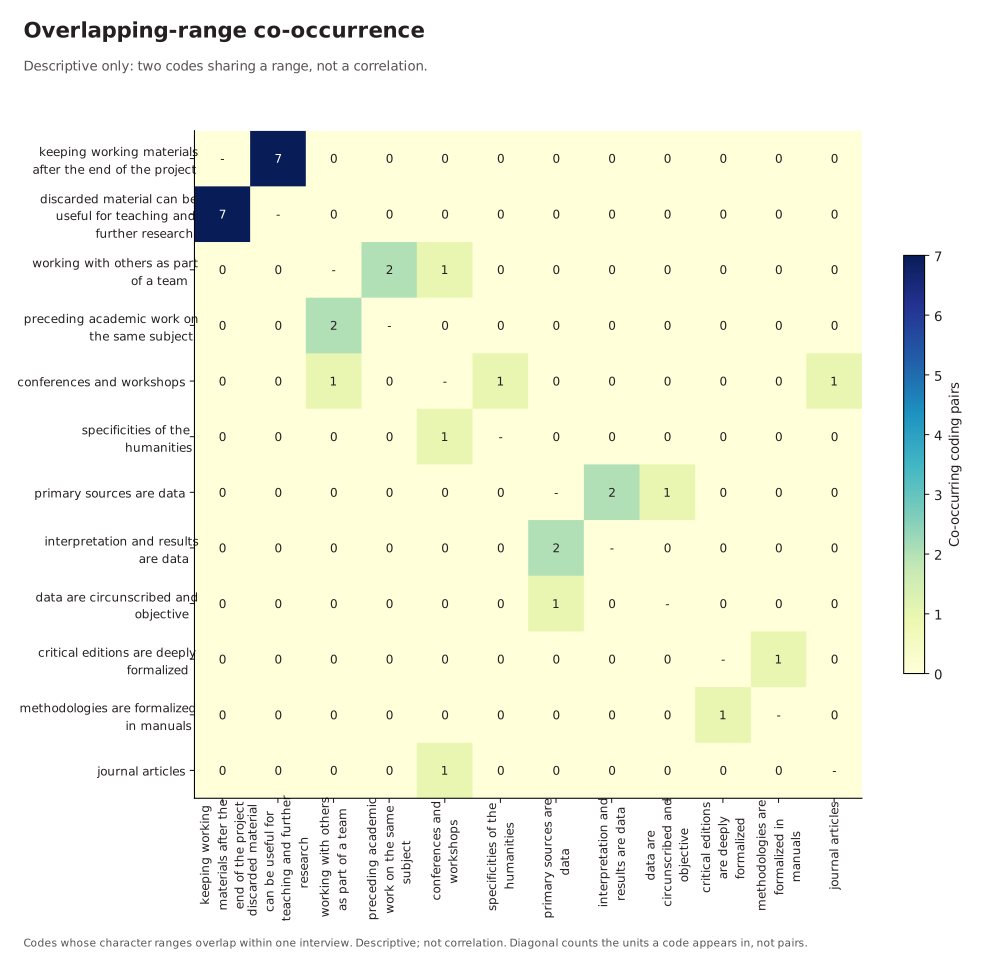
Which codes share a stretch of text?
Only the exported non-zero pairs are shown. Blank cells carry no CSV value; the original figure remains available below.
Arrow keys to explore · Enter to locate the count row · Escape to clear
Only exported non-zero off-diagonal pairs are selectable. Blank and diagonal cells have no value in this CSV.
| code_a | code_b | count |
|---|---|---|
| discarded material can be useful for teaching and further research | 7 | |
| preceding academic work on the same subject | 2 | |
| conferences and workshops | 1 | |
| working with others as part of a team | 2 | |
| conferences and workshops | 1 | |
| interpretation and results are data | 2 | |
| data are circunscribed and objective | 1 | |
| primary sources are data | 2 | |
| methodologies are formalized in manuals | 1 | |
| primary sources are data | 1 | |
| keeping working materials after the end of the project | 7 | |
| working with others as part of a team | 1 | |
| specificities of the humanities | 1 | |
| journal articles | 1 | |
| conferences and workshops | 1 | |
| critical editions are deeply formalized | 1 |
TABLE.03 preserves the exported non-zero pairs in both directions. The original workbench figure also includes a diagonal; it is not included in this CSV or the interactive view.
A blank pair in the count export is not proof that two ideas are unrelated. These values describe the coded ranges under the chosen rule. Next, return to the codebook’s theme structure.
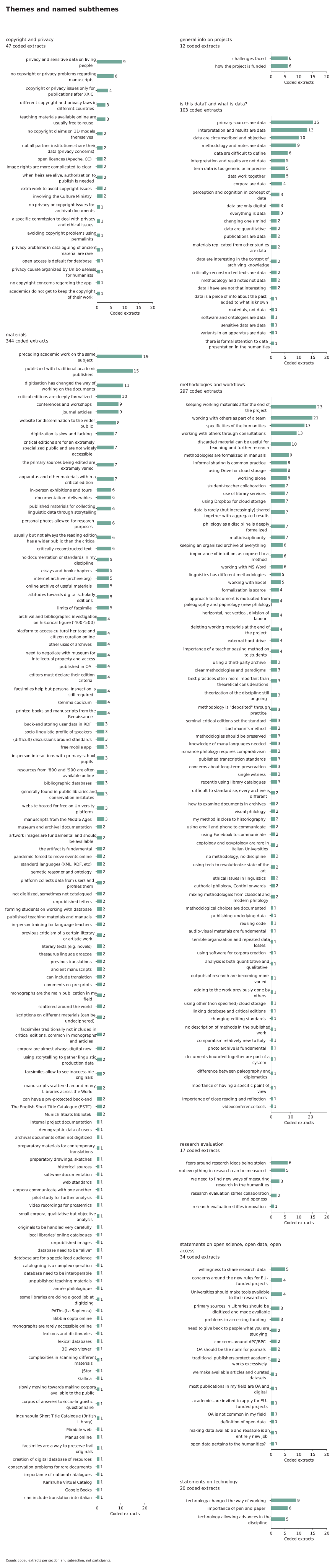
How does the codebook organise the coded material?
Choose one of 8 exported themes. Expand the group to inspect every code without merging its identity.
Arrow keys to explore · Enter to locate the count row · Escape to clear
| section | subsection | count |
|---|---|---|
| preceding academic work on the same subject | 19 | |
| published with traditional academic publishers | 15 | |
| digitisation has changed the way of working on the documents | 11 | |
| critical editions are deeply formalized | 10 | |
| journal articles | 9 | |
| conferences and workshops | 9 | |
| website for dissemination to the wider public | 8 | |
| apparatus and other materials within a critical edition | 7 | |
| the primary sources being edited are extremely varied | 7 | |
| critical editions are for an extremely specialized public and are not widely accessible | 7 | |
| digitization is slow and lacking | 7 | |
| critically-reconstructed text | 6 | |
| usually but not always the reading edition has a wider public than the critical | 6 | |
| personal photos allowed for research purposes | 6 | |
| published materials for collecting linguistic data through storytelling | 6 | |
| documentation: deliverables | 6 | |
| in-person exhibitions and tours | 6 | |
| limits of facsimile | 5 | |
| attitudes towards digital scholarly editions | 5 | |
| online archive of useful materials | 5 | |
| internet archive (archive.org) | 5 | |
| essays and book chapters | 5 | |
| no documentation or standards in my discipline | 5 | |
| printed books and manuscripts from the Renaissance | 4 | |
| stemma codicum | 4 | |
| facsimiles help but personal inspection is still required | 4 | |
| editors must declare their edition criteria | 4 | |
| published in OA | 4 | |
| need to negotiate with museum for intellectual property and access | 4 | |
| other uses of archives | 4 | |
| platform to access cultural heritage and citizen curation online | 4 | |
| archival and bibliographic investigation on historical figure ('400-'500) | 4 | |
| manuscripts from the Middle Ages | 3 | |
| website hosted for free on University platform | 3 | |
| generally found in public libraries and conservation institutes | 3 | |
| bibliographic databases | 3 | |
| resources from '800 and '900 are often available online | 3 | |
| in-person interactions with primary school pupils | 3 | |
| free mobile app | 3 | |
| (difficult) discussions around standards | 3 | |
| socio-linguistic profile of speakers | 3 | |
| back-end storing user data in RDF | 3 | |
| Munich Staats Bibliotek | 2 | |
| The English Short Title Catalogue (ESTC) | 2 | |
| can have a pw-protected back-end | 2 | |
| manuscripts scattered around many Libraries across the World | 2 | |
| facsimiles allow to see inaccessible originals | 2 | |
| using storytelling to gather linguistic production data | 2 | |
| corpora are almost always digital now | 2 | |
| facsimiles traditionally not included in critical editions, common in monographs and articles | 2 | |
| iscriptions on different materials (can be undeciphered) | 2 | |
| scattered around the world | 2 | |
| monographs are the main publication in my field | 2 | |
| comments on pre-prints | 2 | |
| can include translation | 2 | |
| ancient manuscripts | 2 | |
| previous translations | 2 | |
| thesaurus linguae graecae | 2 | |
| literary texts (e.g. novels) | 2 | |
| previous criticism of a certain literary or artistic work | 2 | |
| in-person training for language teachers | 2 | |
| published teaching materials and manuals | 2 | |
| forming students on working with database | 2 | |
| unpublished letters | 2 | |
| not digitized, sometimes not catalogued | 2 | |
| platform collects data from users and profiles them | 2 | |
| sematic reasoner and ontology | 2 | |
| standard languages (XML, RDF, etc) | 2 | |
| pandemic forced to move events online | 2 | |
| the artifact is fundamental | 2 | |
| artwork images are fundamental and should be available | 2 | |
| museum and archival documentation | 2 | |
| can include translation into italian | 1 | |
| Google Books | 1 | |
| Karlsruhe Virtual Catalog | 1 | |
| importance of national catalogues | 1 | |
| conservation problems for rare documents | 1 | |
| creation of digital database of resources | 1 | |
| facsimiles are a way to preserve frail originals | 1 | |
| Manus online | 1 | |
| Mirabile web | 1 | |
| Incunabula Short Title Catalogue (British Library) | 1 | |
| corpus of answers to socio-linguistic questionnaire | 1 | |
| slowly moving towards making corpora available to the public | 1 | |
| Gallica | 1 | |
| JStor | 1 | |
| complexities in scanning different materials | 1 | |
| 3D web viewer | 1 | |
| lexical databases | 1 | |
| lexicons and dictionaries | 1 | |
| monographs are rarely accessible online | 1 | |
| Bibbia copta online | 1 | |
| PAThs (La Sapienza) | 1 | |
| some libraries are doing a good job at digitizing | 1 | |
| année philologique | 1 | |
| unpublished teaching materials | 1 | |
| database need to be interoperable | 1 | |
| cataloguing is a complex operation | 1 | |
| database are for a specialized audience | 1 | |
| database need to be "alive" | 1 | |
| unpublished images | 1 | |
| local libraries' online catalogues | 1 | |
| originals to be handled very carefully | 1 | |
| small corpora, qualitative but objective analysis | 1 | |
| video recordings for prossemics | 1 | |
| pilot study for further analysis | 1 | |
| corpora communicate with one another | 1 | |
| web standards | 1 | |
| software documentation | 1 | |
| historical sources | 1 | |
| preparatory drawings, sketches | 1 | |
| preparatory materials for contemporary translations | 1 | |
| archival documents often not digitized | 1 | |
| demographic data of users | 1 | |
| internal project documentation | 1 | |
| keeping working materials after the end of the project | 23 | |
| working with others as part of a team | 21 | |
| specificities of the humanities | 17 | |
| working with others through consultations | 13 | |
| discarded material can be useful for teaching and further research | 10 | |
| methodologies are formalized in manuals | 9 | |
| working alone | 8 | |
| using Drive for cloud storage | 8 | |
| informal sharing is common practice | 8 | |
| multidisciplinarity | 7 | |
| philology as a discipline is deeply formalized | 7 | |
| data is rarely (but increasingly) shared together with aggregated results | 7 | |
| using Dropbox for cloud storage | 7 | |
| use of library services | 7 | |
| student-teacher collaboration | 7 | |
| working with MS Word | 6 | |
| importance of intuition, as opposed to a method | 6 | |
| keeping an organized archive of everything | 6 | |
| working with Excel | 5 | |
| linguistics has different methodologies | 5 | |
| importance of a teacher passing method on to students | 4 | |
| external hard-drive | 4 | |
| deleting working materials at the end of the project | 4 | |
| horizontal, not vertical, division of labour | 4 | |
| approach to document is mutuated from paleography and papirology (new philology) | 4 | |
| formalization is scarce | 4 | |
| recentio using library catalogues | 3 | |
| single witness | 3 | |
| concerns about long-term preservation | 3 | |
| published transcription standards | 3 | |
| romance philology requires comparativism | 3 | |
| knowledge of many languages needed | 3 | |
| methodologies should be preserved | 3 | |
| Lachmann's method | 3 | |
| seminal critical editions set the standard | 3 | |
| methodology is "deposited" through practice | 3 | |
| theorization of the discipline still ongoing | 3 | |
| best practices often more important than theoretical considerations | 3 | |
| clear methodologies and paradigms | 3 | |
| using a third-party archive | 3 | |
| mixing methodologies from classical and modern philology | 2 | |
| authorial philology, Contini onwards | 2 | |
| ethical issues in linguistics | 2 | |
| using tech to revolutionize state of the art | 2 | |
| no methodology, no discipline | 2 | |
| coptology and egyptology are rare in Italian Universities | 2 | |
| using Facebook to communicate | 2 | |
| using email and phone to communicate | 2 | |
| my method is close to historiography | 2 | |
| visual philology | 2 | |
| how to examine documents in archives | 2 | |
| difficult to standardise, every archive is different | 2 | |
| videoconference tools | 1 | |
| importance of close reading and reflection | 1 | |
| importance of having a specific point of view | 1 | |
| difference between paleography and diplomatics | 1 | |
| documents bounded together are part of a system | 1 | |
| photo archive is fundamental | 1 | |
| comparatism relatively new to Italy | 1 | |
| no description of methods in the published work | 1 | |
| changing editing standards | 1 | |
| linking database and critical editions | 1 | |
| using other (non specified) cloud storage | 1 | |
| adding to the work previously done by others | 1 | |
| outputs of research are becoming more varied | 1 | |
| analysis is both quantitative and qualitative | 1 | |
| using software for corpora creation | 1 | |
| terrible organization and repeated data losses | 1 | |
| audio-visual materials are fundamental | 1 | |
| reusing code | 1 | |
| publishing underlying data | 1 | |
| methodological choices are documented | 1 | |
| primary sources are data | 15 | |
| interpretation and results are data | 13 | |
| data are circunscribed and objective | 10 | |
| methodology and notes are data | 9 | |
| data are difficult to define | 6 | |
| data work together | 5 | |
| term data is too generic or imprecise | 5 | |
| interpretation and results are not data | 5 | |
| corpora are data | 4 | |
| everything is data | 3 | |
| data are only digital | 3 | |
| perception and cognition in concept of data | 3 | |
| data I have are not that interesting | 2 | |
| methodology and notes not data | 2 | |
| critically-reconstructed texts are data | 2 | |
| data are interesting in the context of archiving knowledge | 2 | |
| materials replicated from other studies are data | 2 | |
| publications are data | 2 | |
| data are quantitative | 2 | |
| changing one's mind | 2 | |
| there is formal attention to data presentation in the humanities | 1 | |
| variants in an apparatus are data | 1 | |
| sensitive data are data | 1 | |
| software and ontologies are data | 1 | |
| materials, not data | 1 | |
| data is a piece of info about the past, added to what is known | 1 | |
| privacy and sensitive data on living people | 9 | |
| no copyright or privacy problems regarding manuscripts | 6 | |
| copyright or privacy issues only for publications after XX C | 4 | |
| teaching materials available online are usually free to reuse | 3 | |
| different copyright and privacy laws in different countries | 3 | |
| involving the Culture Ministry | 2 | |
| extra work to avoid copyright issues | 2 | |
| when heirs are alive, authorization to publish is needed | 2 | |
| image rights are more complicated to clear | 2 | |
| open licences (Apache, CC) | 2 | |
| not all partner institutions share their data (privacy concerns) | 2 | |
| no copyright claims on 3D models themselves | 2 | |
| academics do not get to keep the copyright of their work | 1 | |
| no copyright concerns regarding the app | 1 | |
| privacy course organized by Unibo useless for humanists | 1 | |
| open access is default for database | 1 | |
| privacy problems in cataloguing of ancient material are rare | 1 | |
| avoiding copyright problems using permalinks | 1 | |
| a specific commission to deal with privacy and ethical issues | 1 | |
| no privacy or copyright issues for archival documents | 1 | |
| willingness to share research data | 5 | |
| Universities should make tools available to their researchers | 4 | |
| concerns around the new rules for EU-funded projects | 4 | |
| problems in accessing funding | 3 | |
| primary sources in Libraries should be digitized and made available | 3 | |
| traditional publishers protect academic works excessively | 2 | |
| OA should be the norm for journals | 2 | |
| concerns around APC/BPC | 2 | |
| need to give back to people what you are studying | 2 | |
| open data pertains to the humanities? | 1 | |
| making data available and reusable is an entirely new job | 1 | |
| definition of open data | 1 | |
| OA is not common in my field | 1 | |
| academics are invited to apply for EU-funded projects | 1 | |
| most publications in my field are OA and digital | 1 | |
| we make available articles and curated datasets | 1 | |
| technology changed the way of working | 9 | |
| importance of pen and paper | 6 | |
| technology allowing advances in the discipline | 5 | |
| fears around research ideas being stolen | 6 | |
| not everything in research can be measured | 5 | |
| we need to find new ways of measuring research in the humanities | 3 | |
| research evaluation stifles collaboration and openess | 2 | |
| research evaluation stifles innovation | 1 | |
| how the project is funded | 6 | |
| challenges faced | 6 |
The theme membership comes from the codebook. The exported layout orders groups and bars by their counts; it does not establish that a larger group explains the others.
The same material can carry more than one code. To see how the set of encountered codes grows across files, continue to accumulation.
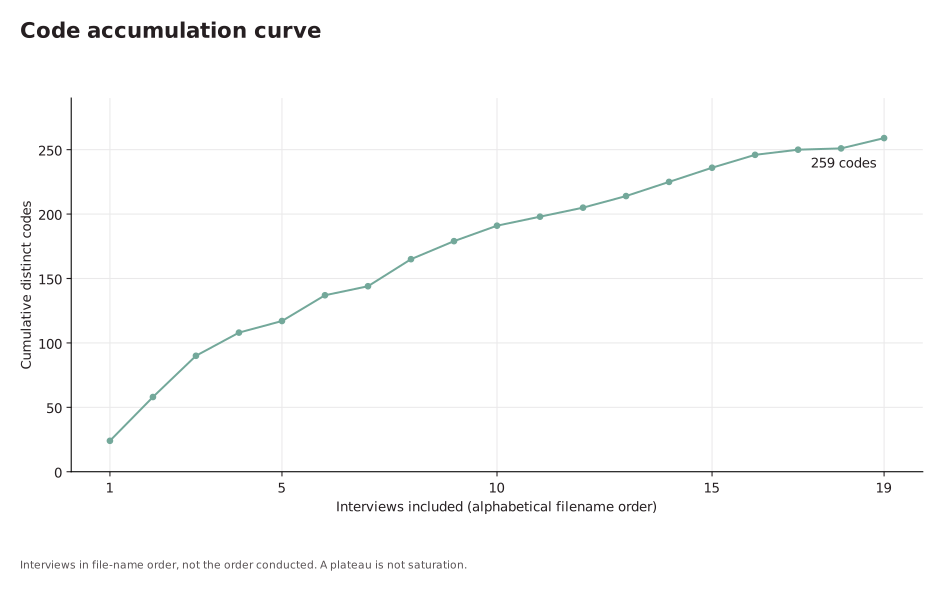
How does the set of encountered codes grow as files are added?
The curve adds interviews in file-name order. TABLE.05 preserves the exported step, case, cumulative total and number of newly encountered codes.
Arrow keys to explore · Enter to locate the count row · Escape to clear
| step | case | cumulative | new |
|---|---|---|---|
| interview01.txt | 24 | 24 | |
| interview02.txt | 58 | 34 | |
| interview03.txt | 90 | 32 | |
| interview04.txt | 108 | 18 | |
| interview05.txt | 117 | 9 | |
| interview06.txt | 137 | 20 | |
| interview07.txt | 144 | 7 | |
| interview08.txt | 165 | 21 | |
| interview09.txt | 179 | 14 | |
| interview10.txt | 191 | 12 | |
| interview11.txt | 198 | 7 | |
| interview12.txt | 205 | 7 | |
| interview13.txt | 214 | 9 | |
| interview14.txt | 225 | 11 | |
| interview15.txt | 236 | 11 | |
| interview16.txt | 246 | 10 | |
| interview17.txt | 250 | 4 | |
| interview18.txt | 251 | 1 | |
| interview19.txt | 259 | 8 |
The final exported point is 259 distinct codes encountered across 19 interviews, compared with 317 codes defined in the full codebook.
The route through the curve depends on the order of the files. A slower rise alone does not decide whether the research is complete. Finish with the counting rules and export record.
This worked example describes existing coding counts. For your own Research report, select one method in Export: Thematic Analysis, Qualitative Content Analysis or Qualitative Comparative Analysis. Its saved name and process map accompany HTML, editable Word and the report ZIP. Explore the three method maps.
Follow each number back to its export.
The page reads the workbench’s SVGs and CSVs. It checks every listed file against the manifest’s SHA-256 and byte length before showing the report. Count tables retain the exported rows and order. The unit statements below come directly from that same manifest.
These descriptive views do not replace interpretation of the interviews. For the same workflow in the interface,open the workbench.